eQualityproject.ca is live!
For current information on our research and publications, please visit www.equalityproject.ca

For current information on our research and publications, please visit www.equalityproject.ca
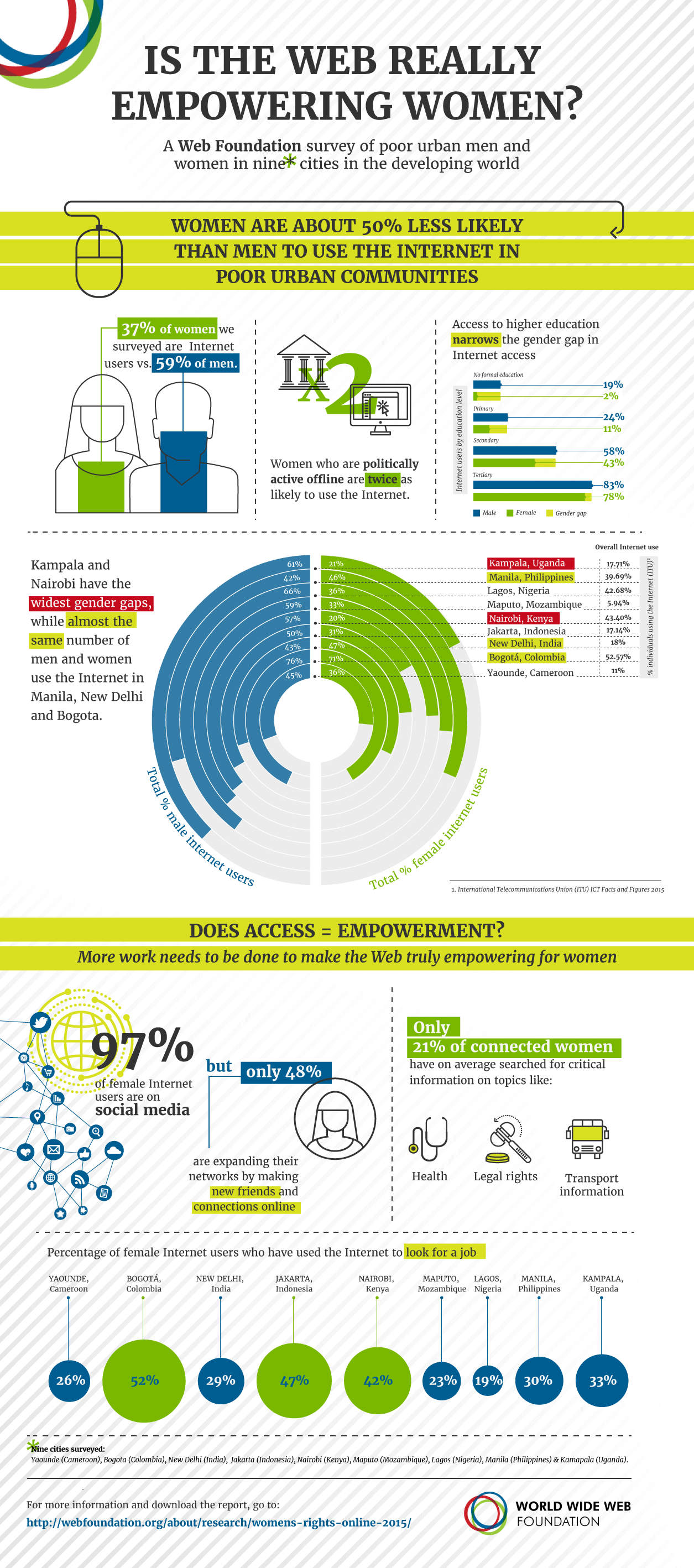
The World Wide Web Foundation has released its final report on women’s rights online. As the Foundation describes, “the dramatic spread of mobile phones is not enough to get women online, or to achieve empowerment of women through technology. The study, based on a survey of thousands of poor urban men and women across nine developing countries, found that while nearly all women and men own a phone, women are still nearly 50% less likely to access the Internet than men in the same communities, with Internet use reported by just 37% of women surveyed. Once online, women are 30-50% less likely than men to use the Internet to increase their income or participate in public life.”
The full report can be downloaded here.
An infographic summarizing the major findings can be viewed here.
For additional information, please see the conference poster: Project Shift_Ottawa or to register: click here.
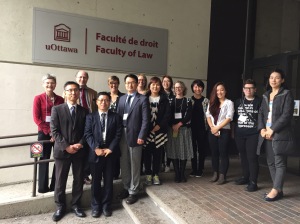 Co-leaders of The eGirls Project and The eQuality Project, Professors Jane Bailey (uOttawa Faculty of Law) and Valerie Steeves (uOttawa Dept of Criminology), met with a delegation of seven officials from South Korea to discuss the issues of online hate propaganda and cyberbullying. The meeting took place in the Faculty of Law’s Human Rights Research and Education Centre and included involvement from the Centre’s Director John Packer and Assistant Director Viviana Fernandez.
The Korean delegation included representatives from the National Human Rights Commission of Korea, the Korean Ministry of Justice and the Anti-Corruption and Civil Rights Commission of the Republic of Korea. The discussion was enriched by the participation of other eQuality Project members Leslie Regan Shade (eQuality Project co-investigator), Sarah Heath (eQuality Project manager) and Dillon Black of the Ottawa Coalition to End Violence Against Women (an eQuality Project partner organization).
Building on the findings from The eGirls Project,
The eQuality Project is investigating youth perspectives of privacy, equality, online harassment and “cyberbullying”, including the impact that online behavioural targeting of youth may have on these kinds of behaviours.
The eGirls team is expanding and launching a new $2.5 million seven year partnership funded by the Social Sciences and Humanities Research Council.
The project will use a highly innovative approach to examine privacy, online behavioural targeting and cyberbullying through an equality lens. The economic model behind e-commerce – disclosure of information in exchange for services – leads youth to drop terabytes of data (often unknowingly) as they go about their daily lives. This data is used in a wide variety of ways, including behavioural marketing that shapes attitudes and behaviours; and profiling, which — as the eGirls Project demonstrated — can also reinforce mainstream stereotypes and lead to discrimination and cyberbullying.
Our new partnership of research and policy institutes, policymakers, educators, community organizations, youth and scholars from Canada, the United States, the United Kingdom and Hong Kong will generate much-needed new knowledge, give youth a voice in best practices, inform digital economic policies, especially with respect to privacy, and reinvigorate the cyberbullying debate by identifying evidence-based policies that promote healthy relationships and respect for equality online.
We’re particularly proud to be one of only 15 projects chosen by SSHRC from a highly competitive pool of over 100 researchers from across the country.
We are excited to announce the launch of eGirls, eCitizens, a collective volume edited by Professors Bailey and Steeves (and featuring chapters by eGirls researchers Jacquie Burkell, Priscilla Regan, Madelaine Saginur, Trevor Scott Milford and Sarah Heath. eGirls, eCitizens will be published by uOttawa Press and is available for purchase or free electronic download here. The volume will be launched on June 3, 2015 from 4-5pm, at the Expo Event Space (Montpetit gym), during Congress of Social Sciences & Humanities 2015, hosted by the University of Ottawa. For more details on the contents of this edited volume, please click the “research” tab above.
eGirls researchers will also be presenting in two panels at the Congress of Social Sciences Humanities 2015, both held on 05 June at the University of Ottawa.
A round-table discussion by contributors to eGirls, eCitizens (uOttawa Press, 2015) will be held at the Canadian Communication Association Conference from 10:15 am – 11:45 am at STE C0136. The panel presentation, entitled “eGirls, eCitizens: A Dialogue on Theory and Policy”, will highlight the contributions of several authors of the eGirls, eCitizens volume, including Valerie Steeves, Jane Bailey, Leslie Regan Shade, Madelaine Saginur, Trevor Scott Milford and Sarah Heath. The full schedule for this panel can be seen here.
Later in the day, Professors Steeves and Bailey, together with Matthew Johnson of MediaSmarts and Jordan Fairbairn of Carleton University, will lead an author meets reader session to discuss their contributions to eGirls, eCitizens (uOttawa Press, 2015) at the Canadian Law & Society Conference, also held at the University of Ottawa (FTX 133), from 3:45 – 5:15 pm.
On January 28, Professor Bailey spoke at Data Privacy Day in Calgary, Alberta. The event will took place at the MacDougall Centre, where Professor Bailey presented “The eGirls Project: Gender, Privacy and Equality in Online Social Networking”. Slides from this presentation to follow!
On January 21-23, Professor Steeves presented at the 8th Annual International Computers, Privacy and Data Protection Conference in Brussels, Belgium. Professor Steeves spoke on two panels: “Feminist Perspectives on Privacy and Data Protection” and “Bentham Goes to School: Surveillance and Student Privacy in the Classroom”. Slides to follow – watch this space!
On December 8, Professors Steeves and Bailey spoke at the Canadian Access and Privacy Association in Ottawa. Professor Steeves presented “Young Canadians in a Wired World Data on Privacy” and Professors Bailey and Steeves presented “eGirls: gender, privacy, cyberbullying and equality in online social networking”. Slides from these presentations can be downloaded here!
We are proud to announce the forthcoming publication of The eGirls Project’s book volume, eGirls, eCitizens: Putting Technology, Theory and Policy Into Dialogue with Girls’ and Young Women’s Voices. Edited by Jane Bailey and Valerie Steeves, this volume will feature a collection of essays from eGirls Project researchers as well as invited contributions from other scholars working in the field. eGirls, eCitizens will be available in spring 2015 from uOttawa Press.
Online connectivity is rapidly becoming essential to social, cultural, economic and political participation, especially among girls and young women who are leading producers of online content. Interestingly, initially utopic predictions from policymakers about the pot of gold sitting at the end of the information superhighway and from critical scholars about the emancipatory potential of participation in digital media are increasingly interlaced with dystopic concerns associated with the mass uptake of networked technologies by youth, particularly girls and young women. Policymakers have tended to focus upon issues such as online child pornography, online luring, cyberbullying and non-consensual disclosure of intimate images. Critical scholars, in turn, have raised concerns about misuse of personal information, online misogyny, racism and homophobia, poor digital literacy skills, and underlying economic models that shape users into consumers, rather than citizens. And yet, all too often, girls’ voices are left out of theoretical, policy and educational dialogue about online issues that directly affect them. This collection of essays reframes the discussion in ways that make space for more equitable and empathetic responses, rather than polarized utopic/dystopic debate. It analyzes the equality, privacy and gender performativity implications of the digital environment and its impacts on girls’ online participation; assesses the ways in which stakeholders construct girls in theoretical, policy and educational discourses; and suggests future approaches and best practices that are premised on girls’ own understandings of their needs and aspirations in an increasingly digitized society.
Click here to find out more about this exciting collection, and click here for its table of contents and to read abstracts for each chapter!
 The eGirls Project